
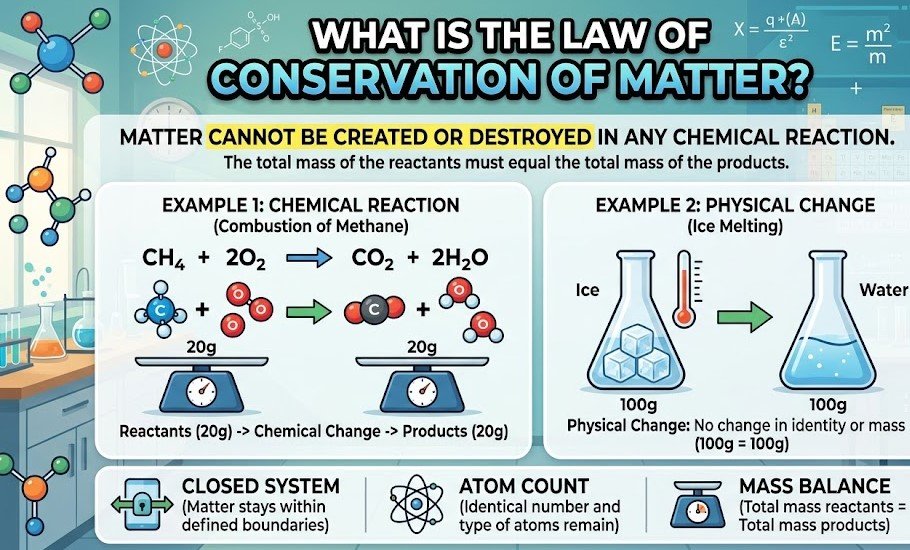
The what is the law of conservation of matter is a basic scientific principle that explains that matter cannot be created or destroyed during a chemical reaction, it only changes its form. This means that when substances react with each other, the total amount of matter before the reaction is always equal to the total amount after the reaction. It is one of the most important ideas in chemistry and physics because it helps us understand how materials behave in the natural world.
This law also shows that atoms are never lost or gained in ordinary chemical reactions. Instead, they are simply rearranged to form new substances with different properties. For example, when something burns or rusts, the material changes appearance, but the total mass of all substances remains the same. This makes the what is the law of conservation of matter essential for understanding chemical changes in everyday life.
Historical Background and Scientific Development
The what is the law of conservation of matter was first clearly explained by the French scientist Antoine Lavoisier in the 18th century. He is often called the father of modern chemistry because his experiments proved that mass remains constant during chemical reactions. His careful measurements showed that substances do not disappear or appear out of nowhere during a reaction.
Lavoisier’s discoveries changed the way scientists understood chemistry. Before his work, many people believed that matter could be destroyed or created during reactions. However, his experiments using closed systems proved that total mass always stays the same. This finding became a foundation for modern scientific study and is still used in education and research today.
Core Principle and Scientific Explanation
The core idea of the what is the law of conservation of matter is that atoms are indestructible in normal chemical reactions. When a reaction occurs, the bonds between atoms break and new bonds form, but the atoms themselves do not disappear. They simply rearrange into new combinations to form different substances.
This means that the number of atoms before and after a reaction always stays the same. Scientists use balanced chemical equations to represent this idea clearly. These equations help show that every atom in the reactants is accounted for in the products, ensuring that mass is conserved in all chemical processes.
Real-Life Examples of Conservation of Matter
The what is the law of conservation of matter can be seen in many real-life situations. One common example is burning wood, where the wood turns into ash, smoke, and gases. Even though the form changes, the total mass of all products remains equal to the original wood and oxygen used in the reaction.
Another example is rusting iron, where iron reacts with oxygen to form rust. Although the metal changes color and texture, no matter is lost during the process. It is simply combined with oxygen from the air to form a new substance. These examples show that matter only changes form, not quantity.
Applications in Chemistry and Physics
The what is the law of conservation of matter is widely used in chemistry to balance equations and predict reaction outcomes. Scientists rely on it to ensure that all atoms are accounted for in chemical reactions, which helps in accurate calculations and experiments.
In physics, this law is important for understanding how matter behaves in different systems. It is also used in environmental science to study natural cycles such as the carbon cycle. These applications show how essential the law is for scientific research and practical understanding of the physical world.
Importance in Scientific Research and Education
The what is the law of conservation of matter is a key concept in science education because it helps students understand how chemical reactions work. It builds a strong foundation for learning more advanced topics in chemistry and physics.
In scientific research, this law ensures accuracy in experiments and helps scientists develop new materials and technologies. It is used in laboratories, industries, and academic studies to maintain consistency and reliability in results.
Common Misconceptions About Matter Conservation
The what is the law of conservation of matter is often misunderstood by people who think matter disappears during reactions like burning. In reality, matter is only transformed into gases or other forms that may not always be visible.
Another misconception is that mass can be lost in open systems. However, when properly measured in a closed system, the total mass remains constant. These misunderstandings highlight the importance of studying the law carefully to understand its true meaning.
Modern Relevance in Science and Technology
The what is the law of conservation of matter remains highly important in modern science and technology. It is used in chemical engineering, environmental studies, and industrial processes to ensure accurate production and analysis of materials.
Today, advanced scientific tools continue to confirm this law in both small-scale and large-scale systems. It remains a fundamental principle that supports innovation and helps scientists understand the behavior of matter in the universe.
Conclusion
The what is the law of conservation of matter is a fundamental scientific law that states matter cannot be created or destroyed, only transformed. It explains how substances change during chemical reactions while maintaining the same total mass. This principle is essential in chemistry, physics, education, and research because it helps scientists understand and predict how the physical world works. Its importance continues to grow in modern science and technology.
FAQs
What is the law of conservation of matter?
It states that matter cannot be created or destroyed, only changed in form.
Who discovered this law?
It was developed by Antoine Lavoisier in the 18th century.
Does matter ever disappear?
No, it only changes form during physical or chemical reactions.
Why is this law important?
It helps scientists balance equations and understand chemical reactions.
For More Update Stay Tuned With: World Profit Web