
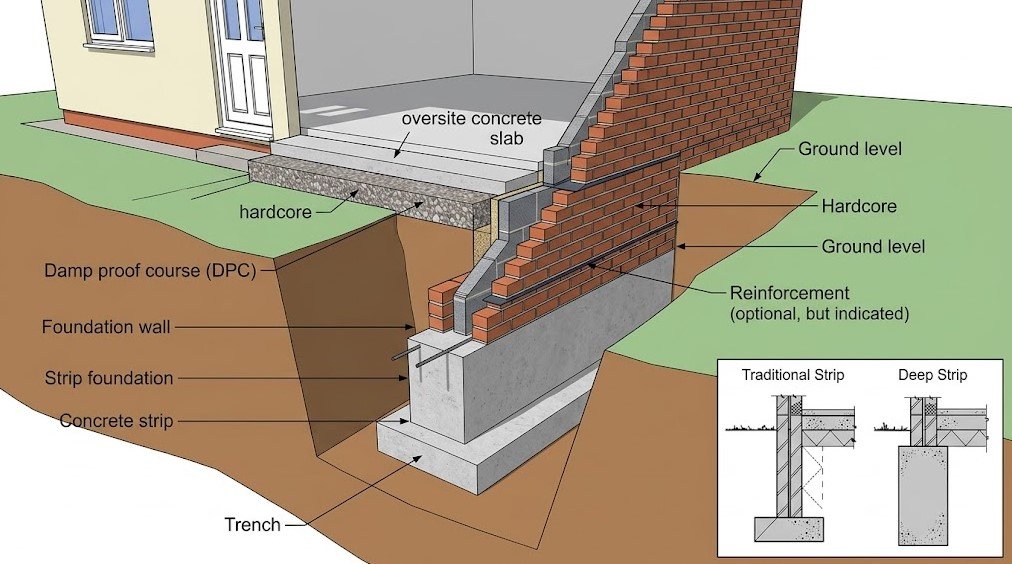
A strip foundation is a type of shallow foundation that consists of a continuous strip of concrete placed under load-bearing walls. Its main purpose is to spread the weight of a building evenly across a larger area of soil so that the ground does not become overloaded at any single point. This helps prevent structural problems such as uneven settlement, cracks in walls, or long-term instability. Strip foundations are widely used in residential buildings, especially for houses where the loads are moderate and the soil has reasonable strength.
In simple construction terms, a strip foundation acts like a strong base belt running under the walls of a structure. The load from the walls is transferred into this concrete strip, which then distributes it safely into the ground beneath. Builders prefer this system because it is straightforward to construct, requires less excavation compared to deep foundations, and is cost-effective for small to medium-sized projects. It is especially suitable when the building design includes continuous load-bearing walls rather than isolated column points.
Another important aspect of strip foundations is that their design depends heavily on soil conditions. Engineers typically conduct a soil investigation before construction to ensure the ground can support the structure safely. If the soil is stable and has good bearing capacity, a strip foundation performs very efficiently. However, in weaker soils, adjustments such as increased depth or reinforcement may be needed to maintain safety and durability.
Types of Strip Foundation
There are several types of strip foundation, and each one is selected based on the building load, soil condition, and structural requirements. The most common type is the plain concrete strip foundation, which is made of unreinforced concrete and is typically used for small residential buildings. It is simple in design and works well when the soil has good bearing capacity and the load from the structure is relatively light. This type is widely used because it is cost-effective and easy to construct without complex engineering processes.
Another important type is the reinforced strip foundation, which includes steel reinforcement bars embedded within the concrete. This design increases the strength and flexibility of the foundation, making it suitable for structures that carry heavier loads or are built on slightly weaker soil conditions. Reinforcement helps control cracking and improves long-term durability, especially in areas where soil movement or minor settlement may occur over time.
The third type is the deep strip foundation, which is used when the upper soil layers are weak or unstable. In this case, the foundation is placed deeper into the ground to reach stronger, more stable soil layers. This type is more expensive and requires more excavation work, but it provides greater stability for structures built in challenging ground conditions. Engineers often recommend this option when surface soil alone cannot safely support the building load.
Materials and Design Considerations
The construction of a strip foundation mainly depends on selecting the right materials and ensuring a proper structural design. The most commonly used material is concrete, which provides the necessary strength and durability to carry building loads over time. In many cases, reinforced concrete is used, where steel bars are added to improve resistance against cracking and bending. The quality of materials directly affects the performance of the foundation, making it essential to use standard-grade cement, clean aggregates, and properly mixed concrete for long-lasting results.
Design considerations play an equally important role in ensuring the stability of a strip foundation. Engineers must carefully analyze the soil bearing capacity, as this determines how much load the ground can safely support. If the soil is strong, a shallow and simple design may be sufficient, but if it is weaker, the foundation may need to be wider or deeper to distribute the load effectively. Load distribution from walls is also calculated precisely to avoid uneven settlement or structural imbalance over time.
Another key factor in design is the width and depth of the foundation, which must be adjusted according to the building size and weight. Wider foundations are used to spread loads over a larger area, while deeper foundations are required in unstable soil conditions or frost-prone regions. Proper drainage planning is also important, as water accumulation around the foundation can weaken the soil and reduce its load-bearing capacity. Careful attention to these design elements ensures that the strip foundation performs safely and efficiently throughout the life of the structure.
Construction Process Step-by-Step
The construction of a strip foundation follows a systematic process that ensures strength, accuracy, and long-term stability of the structure. It begins with site preparation, where the ground is cleared of vegetation, debris, and loose soil. After this, accurate measurements are taken according to the building plan, and the foundation layout is marked on the ground using strings and pegs. This step is very important because any error in marking can affect the alignment of the entire structure above.
Once the layout is complete, the next stage is excavation. Trenches are dug along the marked lines to the required depth and width, depending on the soil condition and structural load. The base of the trench is then leveled and compacted to create a stable surface for concrete placement. In some cases, a thin layer of lean concrete is added at the bottom to provide a clean and even base before the main foundation is poured.
The third step is pouring concrete and reinforcement placement. If the design includes reinforcement, steel bars are placed inside the trench according to engineering specifications. After that, concrete is poured carefully into the trench, ensuring it fills all gaps and surrounds the reinforcement properly. The concrete is then compacted using tools or vibration methods to remove air pockets and improve strength. Finally, the surface is leveled and left to cure for several days. Proper curing is essential because it allows the concrete to gain full strength and ensures the durability of the strip foundation over time.
Advantages of Strip Foundation
The strip foundation offers several important advantages, which is why it is one of the most commonly used foundation systems in residential and small commercial construction. One of the biggest benefits is its cost-effectiveness. Since it uses relatively simple materials like concrete and does not require deep excavation in most cases, it significantly reduces construction costs compared to deep foundation systems. This makes it an ideal choice for low-rise buildings where budget efficiency is important.
Another major advantage is its simplicity of construction. Strip foundations do not require highly complex machinery or advanced engineering techniques, which makes them easier and faster to build. The process of digging trenches, placing concrete, and leveling is straightforward and can be completed in a short time. Because of this, construction projects using strip foundations often have quicker completion timelines, especially for houses and extensions.
In addition to cost and simplicity, strip foundations also provide good load distribution. They spread the weight of the structure evenly along the length of load-bearing walls, which reduces pressure on the soil and minimizes the risk of uneven settlement. When designed correctly, they offer strong and stable support for buildings, especially in areas with firm and stable soil conditions. This balance of strength and practicality makes the strip foundation a reliable option in many construction projects.
Limitations and Common Problems
Although the strip foundation is widely used and effective for many types of buildings, it also has certain limitations that must be considered during planning and construction. One of the main drawbacks is that it is not suitable for all soil types. In areas where the soil is weak, loose, or highly compressible, a strip foundation may not provide enough stability, leading to uneven settlement or structural movement over time. In such cases, deeper foundation systems are usually required to ensure safety.
Another common issue is its performance under heavy loads. Strip foundations are generally designed for low-rise buildings, so they may not be appropriate for multi-storey structures or buildings with concentrated heavy loads. If used beyond their capacity, the foundation may experience cracking or excessive stress, which can compromise the integrity of the entire structure. Proper structural analysis is essential to avoid such problems.
Moisture and water-related issues can also affect strip foundations. Poor drainage around the foundation can lead to water accumulation, which weakens the surrounding soil and reduces its load-bearing capacity. Over time, this may result in settlement or cracks in the building walls. Additionally, in colder regions, frost action can cause ground movement that impacts the stability of shallow foundations. These limitations highlight the importance of proper soil testing, design accuracy, and site management before constructing a strip foundation.
Applications in Modern Construction
The strip foundation is widely used in modern construction, especially in projects where buildings have load-bearing walls and relatively low structural loads. It is most commonly found in residential houses, where it provides a stable and cost-effective base for single-storey and two-storey structures. Because of its simplicity and reliability, it is often the first choice for builders working on housing developments and small-scale construction projects.
In addition to homes, strip foundations are also used in building extensions and renovations. When an existing structure is expanded, a strip foundation can be easily integrated to support the new load-bearing walls without requiring major changes to the original foundation system. This flexibility makes it highly practical for homeowners who want to add extra rooms or floors without extensive reconstruction work.
Strip foundations are also used in certain small commercial buildings, such as shops, warehouses, and low-rise office spaces. In these cases, the soil conditions must be suitable to ensure long-term stability. Engineers often prefer this foundation type in projects where budget control, speed of construction, and structural simplicity are key priorities. However, for taller or heavily loaded structures, more advanced foundation systems are usually selected instead.
Conclusion
The strip foundation remains one of the most practical and widely used foundation systems in modern construction due to its simplicity, cost efficiency, and suitability for low-rise buildings. It works by distributing the load of load-bearing walls evenly into the ground, helping to maintain structural stability and reduce the risk of uneven settlement. When properly designed and constructed, it provides a strong and reliable base for residential homes, extensions, and small commercial structures. However, its effectiveness largely depends on soil conditions, correct design, and proper construction practices, making site investigation an essential step before use.
Despite some limitations—such as its unsuitability for weak soils and heavy structural loads—the strip foundation continues to be a preferred choice in many construction projects worldwide. Its balance of affordability and functionality makes it especially valuable in housing developments where efficiency and durability are both important.
FAQs
1. What is a strip foundation used for?
A strip foundation is used to support load-bearing walls in low-rise buildings by spreading the structural load evenly across the soil.
2. Is a strip foundation expensive?
No, it is generally cost-effective compared to deep foundation systems because it requires less excavation and simpler construction methods.
3. Can strip foundations be used in all soil types?
No, they are best suited for firm, stable soils. Weak or highly compressible soils may require alternative foundation systems.
4. What is the main advantage of strip foundations?
The main advantage is that they provide a simple, economical, and efficient way to support residential and small buildings.
For More Update Stay Tuned With: World Profit Web