
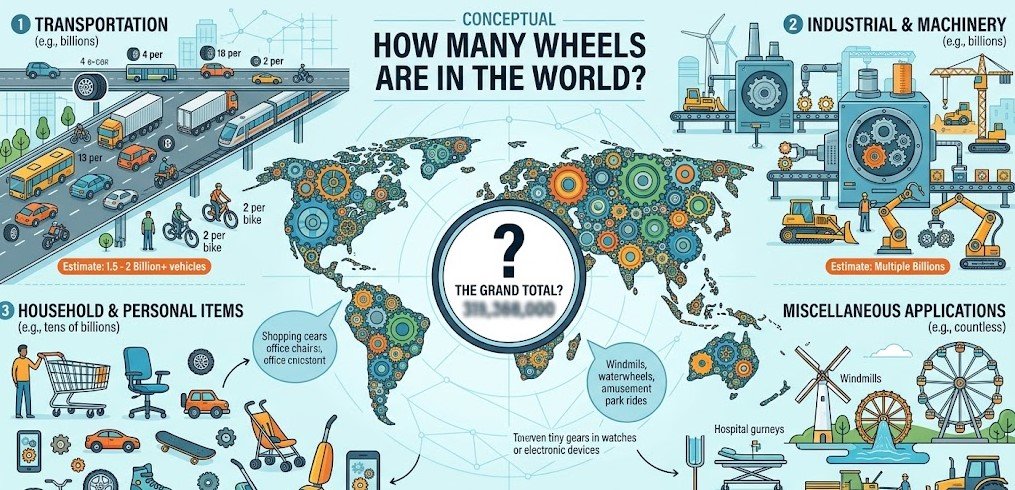
The question how many wheels are in the world might sound unusual at first, but it reveals something fascinating about modern life: almost everything we use depends on wheels in one form or another. From cars, bicycles, and buses to office chairs, shopping carts, suitcases, and industrial machines, wheels are deeply embedded in daily life. They are one of the most important mechanical inventions ever created, yet most people never think about how many exist globally.
Experts suggest that while it is impossible to count every wheel precisely, global estimates place the total in the tens of billions. This includes every type of wheel, from large vehicle tires to tiny wheels inside toys and machinery. The number continues to grow every year due to constant manufacturing and global demand.
The Global Wheel Count: What Experts Estimate
The total number of wheels in the world is not an exact figure, but researchers and industry analysts agree on a broad estimate range. Most studies suggest that there are between 25 billion and 70 billion wheels globally, depending on what is included in the calculation. This wide range exists because wheels are found in far more places than just vehicles, and different studies include different categories in their counting methods.
A commonly referenced midpoint estimate places the global total at around 37 billion wheels. This figure is based on combining data from transportation systems, household goods, industrial machinery, and mass-produced consumer items. Each of these sectors contributes a massive number of wheels, and together they create an astonishing global total that continues to grow every year as new products are manufactured and sold worldwide.
Wheels on Vehicles: Cars, Bikes, and Trucks Breakdown
A major portion of the world’s wheels comes from vehicles, especially cars, motorcycles, bicycles, buses, and trucks. Cars alone contribute billions of wheels globally, and when you include commercial transport like trucks and buses, the number increases significantly. Most passenger cars have four wheels, while larger transport vehicles can have six, eight, or even more depending on their design and load capacity.
Bicycles and motorcycles also add a massive number to the global total because of their widespread use in both developed and developing countries. Bicycles alone are estimated in the billions worldwide, each contributing two wheels. When combined with all motor vehicles, this category forms one of the largest contributors to the total answer of how many wheels are in the world, showing just how dependent global transportation is on this simple but powerful invention.
Everyday Objects That Add Billions of Wheels
Beyond vehicles, a huge number of wheels exist in everyday household and personal items that people use without even noticing. Objects like office chairs, shopping carts, luggage bags, baby strollers, and furniture all rely on small wheels to improve movement and convenience. These items are produced in massive quantities worldwide, which means their collective wheel count becomes extremely significant.
For example, office chairs alone are manufactured in the hundreds of millions globally, each typically having five wheels. Similarly, suitcases with rolling systems are produced in large numbers every year due to increased global travel. When combined, these everyday objects contribute billions of wheels, making them a crucial part of answering how many wheels are in the world and showing that wheels are not limited to transportation alone.
Industrial and Machinery Wheels You Never Think About
Industrial equipment is another major contributor to the total number of wheels in the world, even though these wheels are not always visible to the public. Factories, warehouses, construction sites, and logistics systems all rely heavily on machines that use wheels for movement, transport, and operation. Conveyor systems, forklifts, heavy-duty carts, and automated production lines all include multiple wheels in their design.
In large-scale industries, even a single facility can contain thousands of wheels working together in machinery and transport systems. When you multiply this across millions of factories and industrial units worldwide, the number becomes enormous. These hidden wheels play a critical role in global production and supply chains, and they form an essential part of understanding how many wheels are in the world beyond just vehicles and household items.
Toys, Gadgets, and Small Wheels That Multiply the Numbers
One of the most surprising contributors to the answer of how many wheels are in the world comes from toys and small consumer gadgets. Toy cars, model vehicles, robotics kits, and building sets often include multiple tiny wheels, and they are manufactured in extremely high volumes across the globe. Children’s toys alone account for billions of small wheels when production is added up over decades.
These wheels may be small in size, but their impact on the global total is massive. In fact, toy manufacturing industries in countries like China, the United States, and Europe produce billions of units annually, each containing one or more wheels. When combined with gadgets like rolling robots and miniature mechanical devices, this category becomes one of the most overlooked yet significant contributors to the global wheel count.
Estimated Contribution of Toy and Small Wheels
| Category | Estimated Units Worldwide | Average Wheels per Unit | Total Wheel Contribution |
|---|---|---|---|
| Toy cars | Billions | 4 wheels | Massive (billions) |
| Building sets | Hundreds of millions | 2–8 wheels | High (billions) |
| Robotics toys | Millions | 2–6 wheels | Moderate |
| Model vehicles | Millions | 3–6 wheels | Moderate |
| Misc. gadgets | Millions | 1–4 wheels | Significant |
How Experts Calculate the Total Number of Wheels
Estimating how many wheels are in the world is not done by physically counting them one by one—that would be impossible. Instead, experts use a method called category-based global estimation, where the world is divided into major sectors such as transportation, household goods, industry, and toys. Each category is analyzed separately, and then all results are combined to reach a global estimate.
For example, researchers first estimate the total number of vehicles worldwide and multiply that by the average number of wheels per vehicle. Then they do the same for bicycles, furniture, industrial machines, and toys. Finally, all these values are added together to produce a global figure. This method is widely used in engineering and economic forecasting when exact data cannot be directly measured.
Another important factor is production flow, meaning wheels are constantly being created and removed from use. Every year, millions of new cars, chairs, suitcases, and toys are manufactured, while older ones are discarded. This means the total number of wheels in the world is always changing, which is why estimates remain ranges rather than fixed numbers.
Why There Is No Exact Answer (and Why It Still Matters)
There is no exact answer to how many wheels are in the world because wheels are not tracked as a standalone global statistic. Unlike population or vehicle counts, wheels are part of countless products across industries, and no central database records every single unit. They exist in cars, toys, furniture, machinery, and even disposable items that are constantly being produced and discarded.
Another reason the number is impossible to fix is the continuous cycle of manufacturing and replacement. Every day, new wheels are produced while old ones wear out or are thrown away. Global production chains in transportation, manufacturing, and consumer goods mean the total is always changing. Even if someone calculated an exact number today, it would be outdated within weeks due to ongoing production.
Despite the uncertainty, the question still matters because it highlights how deeply wheels are embedded in modern life. From global trade systems to everyday convenience, wheels are a silent but essential part of human progress, making this estimate more meaningful than the exact number itself.
Conclusion
The question how many wheels are in the world may not have a single exact answer, but it reveals something impressive about modern civilization. Based on global estimates, there are likely tens of billions of wheels worldwide, with most studies placing the number between 25 billion and 70 billion. This includes everything from vehicles and bicycles to furniture, industrial machines, and even toys.
What makes this number truly fascinating is not just its size, but the variety of places wheels appear in everyday life. They support transportation, power industries, improve mobility, and even make entertainment possible through toys and gadgets. While the exact count keeps changing due to constant production, one thing is clear: wheels are one of the most widely used inventions in human history, quietly shaping the way the world moves every single day.
FAQs
1. How many wheels are in the world exactly?
There is no exact number, but estimates suggest between 25 billion and 70 billion wheels globally.
2. What is the most common estimate?
Many experts often cite around 37 billion wheels worldwide as a balanced estimate.
3. Why can’t we count all wheels in the world?
Because wheels are used in millions of different products, and there is no global system tracking them individually.
4. What contributes the most wheels globally?
Vehicles, household items, industrial machines, and toys are the biggest contributors to the total wheel count.
For More Update Stay Tuned With: World Profit Web