
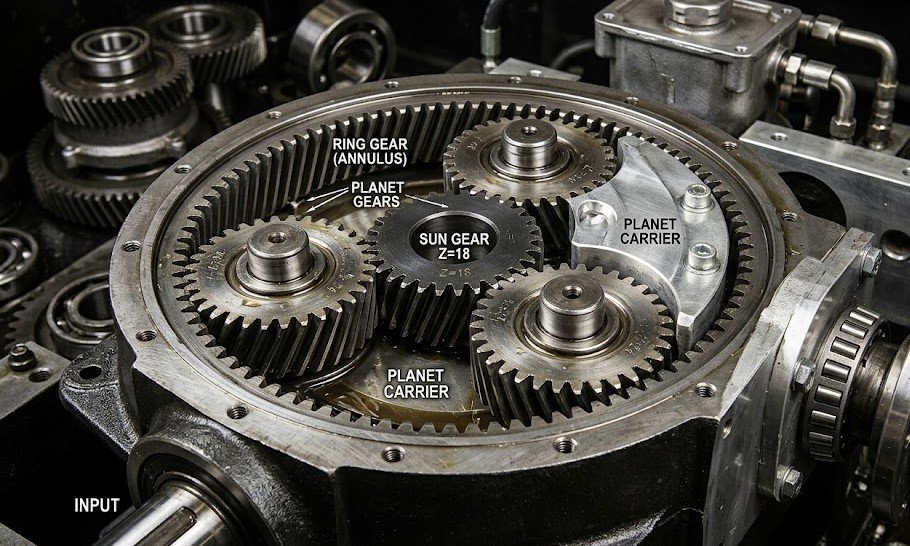
Planetary gears, also known as epicyclic gear systems, are a mechanical arrangement used to transmit motion and torque efficiently between different parts of a machine. This system consists of a central sun gear, multiple planet gears that rotate around it, and an outer ring gear that encloses the system. The focus keyword planetary gears represents a highly efficient gear mechanism that is widely used in modern engineering due to its compact design and high power transmission capability. Unlike simple gear systems, planetary gears distribute load across multiple gears at the same time, which increases strength, reduces wear, and improves overall performance.
These gear systems are commonly found in automatic transmissions, industrial machinery, robotics, and aerospace applications where space and efficiency are critical. The unique structure of planetary gears allows them to handle high torque while remaining small in size, making them ideal for systems that require both power and precision. Their ability to perform multiple functions such as speed reduction, torque multiplication, and directional control makes them one of the most versatile gear systems in mechanical engineering.
Working Principle of Planetary Gears
The working principle of planetary gears is based on the interaction between the sun gear, planet gears, and ring gear. When one component is fixed, driven, or used as an output, the system changes the speed, torque, and direction of motion. For example, when the sun gear rotates, it drives the planet gears, which then rotate around the sun gear while also spinning on their own axes. This motion is controlled by the outer ring gear, which holds the system together and guides the movement.
The focus keyword planetary gears is often associated with high efficiency because the load is shared between multiple planet gears instead of being handled by a single gear. This reduces stress on individual components and allows smooth power transfer. Depending on the configuration, planetary gear systems can increase torque, reduce speed, or reverse motion, making them extremely flexible for different mechanical applications. This adaptability is one of the key reasons they are widely used in advanced machinery and automotive systems.
Main Components of a Planetary Gear System
A planetary gear system consists of three main components that work together to create motion and transmit power. The first is the sun gear, which is located at the center and acts as the primary driver of the system. The second component is the planet gears, which rotate around the sun gear and are mounted on a carrier that holds them in place. The third component is the ring gear, an outer gear that surrounds the planet gears and provides structural support while controlling their movement.
The interaction between these components is what makes planetary gears so efficient and powerful. The planet gears not only rotate around the sun gear but also spin on their own axes, allowing multiple contact points for load distribution. This design reduces wear and increases durability compared to traditional gear systems. The combination of these components creates a compact yet highly effective system capable of handling complex mechanical tasks in various industries.
Types of Planetary Gear Systems
There are several types of planetary gear systems designed to meet different engineering requirements. The most common type is the simple planetary gear set, which includes one sun gear, multiple planet gears, and a ring gear. Another type is the compound planetary gear system, which uses additional gears for increased torque and complex motion control. There are also differential planetary systems that distribute power between multiple outputs and multi-stage planetary systems used in heavy-duty machinery.
Each type of planetary gears system is designed for specific applications where performance requirements vary. For example, simple systems are often used in automotive transmissions, while compound systems are used in industrial equipment that requires higher torque output. Multi-stage systems are used in heavy machinery and aerospace applications where extreme power and precision are needed. The variety of designs makes planetary gear systems highly adaptable across different engineering fields.
Advantages of Planetary Gears
Planetary gears offer several important advantages that make them highly popular in modern engineering. One of the biggest benefits is their ability to deliver high torque in a compact space, making them ideal for applications where size and weight are limited. They also provide high efficiency because the load is evenly distributed across multiple gears, reducing wear and improving durability. Another advantage is smooth and stable operation, which minimizes vibration and noise during performance.
The focus keyword planetary gears is strongly associated with efficiency and versatility. These systems can achieve multiple gear ratios within a single unit, making them highly flexible for different mechanical requirements. They are also highly reliable due to their balanced design, which reduces stress on individual components. This combination of strength, efficiency, and compact design makes planetary gears a preferred choice in advanced engineering systems.
Applications of Planetary Gears
Planetary gears are used in a wide range of industries due to their efficiency and compact structure. In the automotive industry, they are commonly used in automatic transmissions and hybrid vehicle systems. In aerospace engineering, they are used in helicopter rotors and aircraft engines where precision and reliability are essential. They are also widely used in robotics for precise motion control and in industrial machinery for heavy-duty operations.
The versatility of planetary gears makes them suitable for both high-power and precision applications. Wind turbines use them to convert low-speed blade rotation into high-speed electrical generation. Construction and mining equipment also rely on planetary gear systems for handling heavy loads. Their ability to perform efficiently under extreme conditions makes them essential in modern mechanical design.
Limitations and Design Challenges
Despite their many advantages, planetary gears also have some limitations and design challenges. One major issue is their complex structure, which makes manufacturing and assembly more difficult compared to simpler gear systems. This complexity also increases production costs and requires precise engineering to ensure proper alignment and performance.
Another challenge associated with planetary gears is maintenance difficulty. Because of their compact design and multiple interacting components, repairs can be time-consuming and expensive. In some cases, if one component fails, it may affect the entire system. However, despite these limitations, their performance benefits often outweigh the drawbacks in high-performance applications.
Conclusion
Planetary gears are one of the most efficient and powerful mechanical systems used in modern engineering. The focus keyword planetary gears highlights a technology that offers high torque, compact design, and excellent load distribution. From automotive transmissions to aerospace systems, their applications are vast and essential for modern machinery. While they come with some design and maintenance challenges, their advantages make them indispensable in industries that require precision and reliability.
FAQs
What are planetary gears used for?
They are used for transmitting torque and motion in machines like vehicles, robots, and industrial equipment.
Why are planetary gears efficient?
They distribute load across multiple gears, reducing stress and increasing efficiency.
Where are planetary gears commonly found?
They are used in cars, wind turbines, robotics, and aerospace systems.
What is the main advantage of planetary gears?
Their main advantage is high torque output in a compact and efficient design.
For More Update Stay Tuned With: World Profit Web