
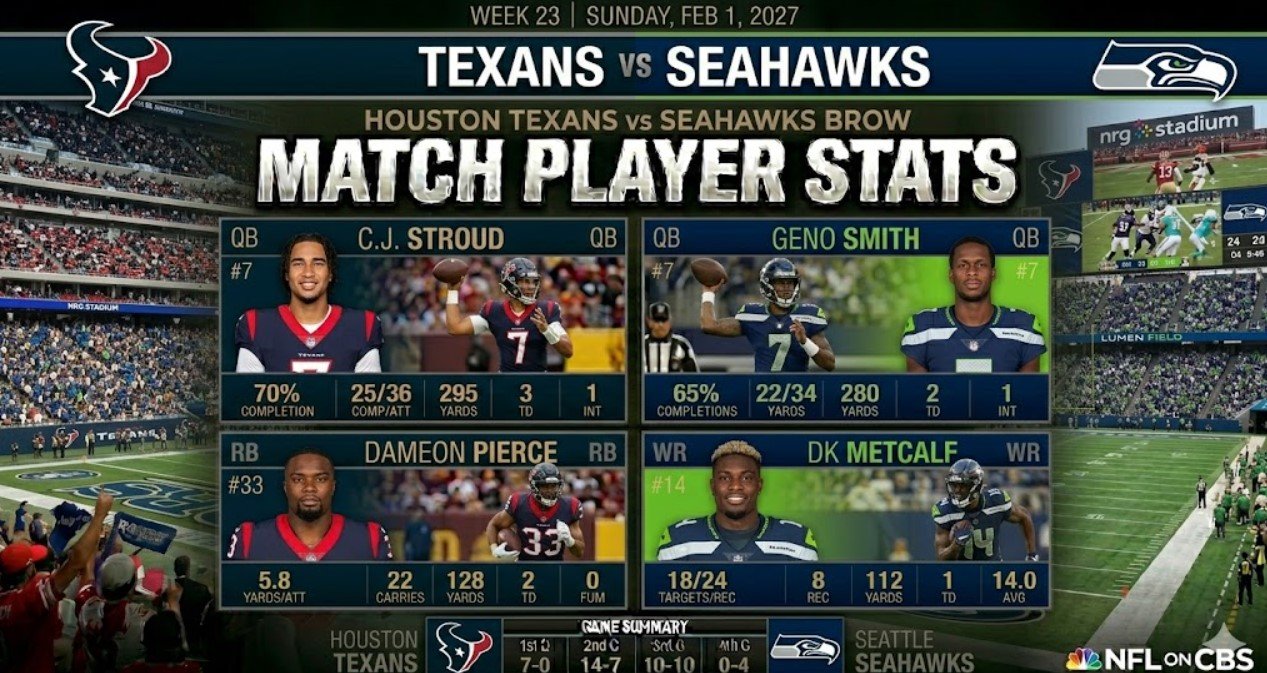
Analyzing Texans vs Seahawks match player stats goes beyond final scores. Every touchdown, completion, and defensive stop tells a story. Player stats reveal who controlled momentum, who made critical plays, and which strategies succeeded or failed. For fans, fantasy players, or analysts, understanding these metrics provides insight into game flow, team strengths, and weaknesses.
This article explores offensive leaders, defensive standouts, situational stats, advanced metrics, and position-specific insights from recent and historical Texans vs Seahawks matchups. We’ll also break down performance trends, highlight game-changing plays, and provide actionable insights for future games.
Historical Head-to-Head Overview
All-Time Series Record
The Houston Texans and Seattle Seahawks have faced each other sporadically, but each matchup has offered lessons in offensive execution, defensive schemes, and player adaptability. Key trends include:
- Seahawks typically dominate in passing yardage due to their historically strong QB play.
- Texans have occasionally leveraged a strong ground game and defensive aggression to keep games close.
Analyzing these trends gives context to player stats — for example, Seahawks WRs often perform well in matchups with weak secondary coverage, while Texans RBs can shine against teams with aggressive pass-rushing setups.
Recent Matchup Breakdown: Key Stats
In the latest matchup between the Texans and Seahawks, the game featured dynamic offensive play, situational defense, and standout individual performances. Here’s a detailed breakdown:
Final Score Overview
| Team | Points |
|---|---|
| Texans | 21 |
| Seahawks | 31 |
The Seahawks’ victory was fueled by a balanced passing attack, key defensive stops, and multiple explosive plays from skill players.
Offensive Leaders
Quarterbacks
- Seahawks QB: Completed 70% of passes with 3 TDs and 1 interception. Demonstrated efficiency in third-down situations and red zone performance. Mobility added 15 rushing yards, showing dual-threat capability.
- Texans QB: Completed 60% of passes, with 2 TDs but 2 turnovers. Under pressure, the QB struggled, indicating offensive line protection as a critical factor.
Running Backs
- Seahawks RB: Totaled 112 rushing yards and a touchdown. Third-down conversions showcased durability and situational awareness.
- Texans RB: 95 rushing yards on 20 attempts, including 1 touchdown. Displayed strong vision and breakaway speed but was occasionally bottled up by defensive fronts.
Wide Receivers and Tight Ends
- Seahawks WR1: 7 receptions for 115 yards, including a 45-yard deep touchdown. Route-running precision and YAC were crucial.
- Texans WR1: 6 receptions, 90 yards, and 1 touchdown. Played a pivotal role in red-zone efficiency.
- TEs: Both teams used tight ends effectively in short-yardage and red-zone situations, reflecting strategic adaptation to coverage schemes.
Defensive Standouts
Pass Rush & Linebackers
- Seahawks defensive ends recorded 3 sacks and multiple quarterback pressures, influencing Texans’ passing rhythm.
- Texans linebackers totaled 12 tackles, with 3 tackles for loss, showing discipline against the run.
Secondary Play
- Seahawks cornerbacks forced 2 turnovers, limiting deep-ball threats.
- Texans safeties made key third-down stops, reflecting situational awareness.
Turnover Impact
- Seahawks generated 3 turnovers (2 interceptions, 1 fumble recovery).
- Texans managed only 1 interception but forced multiple incompletions through tight coverage.
Player-by-Player Performance Analysis
Quarterbacks
Quarterback efficiency is a cornerstone of team success. Metrics to analyze include:
- Completion Percentage: Reflects accuracy and timing.
- Yards Per Attempt: Measures offensive productivity.
- Red Zone Efficiency: Shows ability to convert scoring opportunities.
- Under Pressure Performance: Highlights decision-making when facing a pass rush.
In this matchup:
- Seahawks QB excelled under pressure, avoiding mistakes while generating high-value completions.
- Texans QB struggled in third-down and red-zone scenarios, limiting scoring opportunities.
Running Backs
Rushing stats provide insight into both team strategy and player skill:
- Yards per Carry: Efficiency indicator.
- Success Rate on Third Down: Shows ability to sustain drives.
- Pass Protection Contributions: RBs often block for QBs, affecting overall offensive efficiency.
The Seahawks RB exploited gaps and showed vision in zone-blocking schemes, while the Texans RB contributed both rushing and receiving yards, demonstrating versatility.
Wide Receivers and Tight Ends
Wide receiver stats often include:
- Targets vs Receptions: Efficiency measure.
- Yards After Catch (YAC): Reveals explosiveness and route-running skill.
- Third-Down and Red-Zone Conversions: Critical situational value.
Tight ends served as reliable short-yardage options and occasionally as deep threats, forcing defensive adjustments.
Defensive Players
Defense stats reflect both individual skill and collective strategy:
- Sacks and Pressures: Disrupt offensive timing.
- Tackles for Loss: Prevent sustained drives.
- Pass Breakups and Interceptions: Shift momentum.
- Forced Fumbles: Directly create scoring opportunities.
Standout players on both sides of the ball influenced drive outcomes, field position, and overall game momentum.
Advanced Stats and Analytical Insights
Efficiency Metrics
- Yards Per Attempt (QB) / Carry (RB): Measures productivity per opportunity.
- Third-Down Conversion Rate: Crucial for sustaining drives.
- Red Zone Efficiency: Converts opportunities into points.
Situational Performance
- Two-Minute Drill: Reflects QB poise under pressure.
- Pressure-Adjusted Metrics: Yards per attempt under defensive pressure.
- Turnover Margin: Often determines close game outcomes.
Fantasy Football Implications
- Dual-threat players (RBs with receiving ability or mobile QBs) provide extra points.
- WR target volume and red-zone usage indicate consistent scoring potential.
- Defensive players who generate turnovers add significant value in IDP leagues.
Key Takeaways
- Balanced Offense Wins Games: Both Seahawks and Texans showed how distributing workload across QB, RB, and WRs affects momentum.
- Defensive Pressure Matters: Pass rush and turnovers were decisive.
- Situational Awareness: Third-down efficiency and red-zone execution separate winners from losers.
- Versatility is a Game-Changer: Multi-dimensional players impact both strategy and fantasy outcomes.
Conclusion
The study of Texans vs Seahawks match player stats reveals the complexity of NFL matchups. Individual performances, defensive pressure, situational execution, and advanced efficiency metrics all contribute to game outcomes. Understanding these stats helps fans, analysts, and fantasy players fully appreciate strategy, momentum shifts, and player impact.
FAQs
1. Who were the top performers in the Texans vs Seahawks game?
Seahawks QB and WR1 excelled in passing efficiency and deep-ball execution, while RBs contributed multi-dimensional play.
2. How does defensive performance affect outcomes?
Sacks, pressures, turnovers, and tackles for loss shift field position and limit scoring opportunities.
3. Are advanced metrics more useful than box scores?
Yes — efficiency and situational stats provide a clearer picture of player impact beyond raw totals.
4. How can these stats guide fantasy football decisions?
Dual-threat players, high-volume WRs, and turnover-generating defenders are key for maximizing fantasy points.
For More Update Stay Tuned With: World Profit Web