
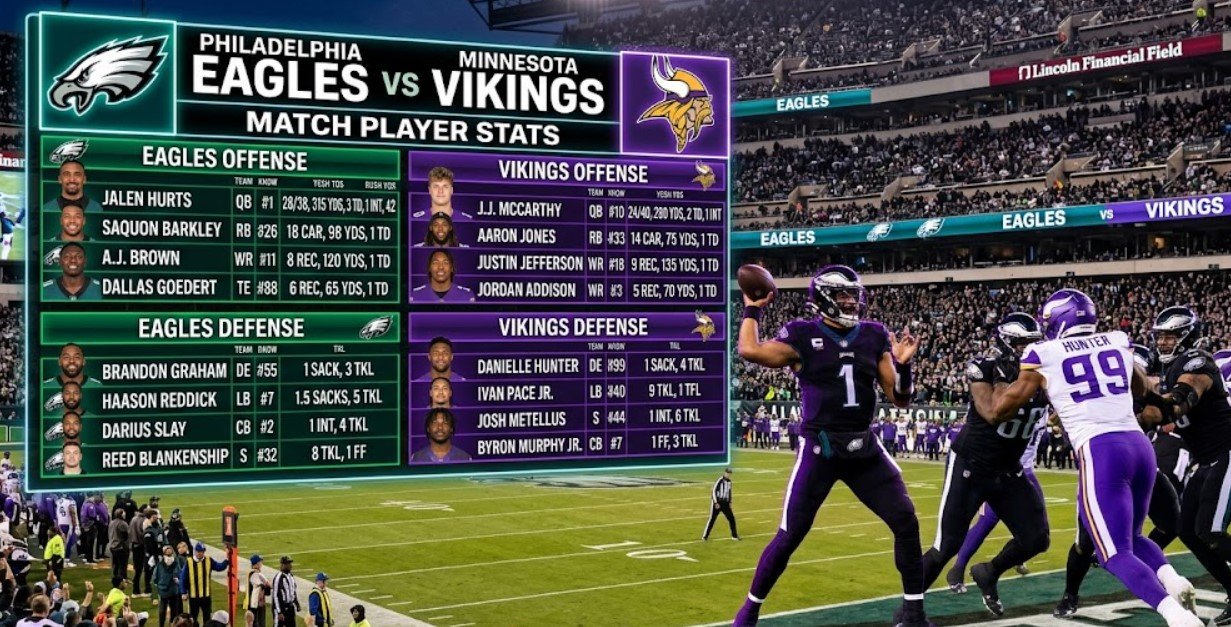
The Philadelphia Eagles and the Minnesota Vikings have consistently delivered some of the most thrilling matchups in the NFL. Known for their high-powered offenses and competitive defenses, these two teams always promise exciting games for football fans. In this detailed article, we examine the latest matchup between these two teams, providing a comprehensive breakdown of the Philadelphia Eagles vs Minnesota Vikings match player stats, analyzing offensive and defensive performances, and exploring the tactical strategies that shaped the game’s outcome.
Game Overview
The game saw a close battle between two playoff-contending teams, with both sides showcasing their strengths in offense and defense. The Eagles ultimately emerged victorious, but the match was a testament to the competitive spirit of both franchises.
From the first whistle, it was clear that the quarterbacks would play a crucial role in determining the outcome. Precision passing, smart decision-making, and exploiting matchups became the key themes of the game. The Eagles managed to maximize their scoring opportunities, while the Vikings relied on explosive plays and maintaining possession to keep themselves in the contest.
Quarterback Performance Breakdown
Jalen Hurts – Philadelphia Eagles
Jalen Hurts demonstrated his versatility and precision throughout the matchup. He completed the majority of his passes with remarkable accuracy, generating significant yardage and three crucial touchdowns. His ability to read the defense and make rapid decisions under pressure kept the Vikings defense on its heels.
Hurts was also effective on the ground, using his mobility to extend plays and keep defenders off balance. Although his rushing yards were limited compared to his passing, the threat of a scramble forced the Vikings to respect both his arm and legs. This dual-threat ability contributed significantly to Philadelphia’s offensive efficiency.
Vikings Quarterback Performance
The Vikings’ quarterback showed resilience but struggled with turnovers at key moments. While he produced respectable passing numbers and connected with multiple receivers, two costly interceptions prevented Minnesota from converting critical drives into points.
Despite the challenges, the Vikings’ quarterback managed to create explosive passing plays, particularly on intermediate routes and deep connections. His performance highlighted the importance of balancing risk and reward in high-stakes matchups.
Rushing Game Analysis
The rushing attack for both teams played a complementary role in their offensive strategies. While the game leaned toward passing, the ground game helped set up critical play-action opportunities and maintain offensive balance.
Eagles Rushing Leaders
Philadelphia’s running backs contributed with steady production, consistently gaining positive yardage and helping to control the pace of certain drives. Their primary role was not only yardage accumulation but also drawing defensive attention, which opened up passing lanes for Hurts and his receivers.
Vikings Rushing Leaders
Minnesota relied on a more traditional ground attack, with their lead back consistently gaining yardage between the tackles. This approach allowed them to sustain drives and force the Eagles’ defense to remain disciplined. Additionally, quarterback scrambles added another layer of unpredictability for the Eagles.
Receiving Analysis
The receiving corps for both teams played a decisive role in the match. Big plays, precise routes, and yards after the catch made the difference in many of the game’s critical moments.
Eagles Receiving Leaders
Philadelphia’s wide receivers and tight ends delivered standout performances. Key players gained significant yardage, contributing directly to the scoring drives. Their ability to separate from defenders, make contested catches, and gain extra yards after contact amplified the impact of Hurts’ precise passing.
Vikings Receiving Leaders
Minnesota’s receivers also contributed, consistently gaining yards and keeping the team competitive. Their performances highlighted the quarterback’s ability to find open targets and exploit mismatches, though turnovers and pressure on the quarterback limited some of their effectiveness.
Defensive Impact
Defense played a pivotal role in this matchup. Both teams recorded sacks, pressures, and critical stops that shaped the momentum of the game.
Eagles Defense
Philadelphia’s defenders made key plays that swung momentum. Interceptions, quarterback pressures, and timely tackles disrupted the Vikings’ offensive rhythm. The defense’s ability to force turnovers directly contributed to the Eagles’ scoring advantage and highlighted the importance of situational awareness.
Vikings Defense
Minnesota’s defense applied consistent pressure, generating some sacks and limiting explosive plays. However, their inability to force turnovers allowed the Eagles to capitalize on scoring opportunities. Despite keeping the game close, certain breakdowns in coverage ultimately determined the outcome.
Key Team Statistics
Analyzing the team statistics provides additional insight into how the game unfolded. Total yards, time of possession, third-down efficiency, and turnover margin all contributed to the final result.
- Total Yards: Both teams accumulated substantial offensive yardage, reflecting the high-powered nature of the matchup.
- Time of Possession: Minnesota maintained a longer possession time but was less efficient in converting drives into points.
- Third-Down Efficiency: Philadelphia’s efficiency on critical downs helped sustain drives and maintain momentum.
- Turnovers: Eagles capitalized on turnovers, which proved decisive in a closely contested game.
Tactical Insights
Several tactical strategies emerged during this matchup:
- Passing Efficiency: Both teams prioritized precise, high-yardage passing plays to move the ball quickly.
- Offensive Balance: Combining short passes with occasional rushing plays kept defenses guessing.
- Defensive Adjustments: Philadelphia’s timely blitzes and coverage schemes created turnovers and limited explosive plays.
- Situational Execution: Effective red-zone offense and efficient scoring drives highlighted Philadelphia’s superior situational execution.
Key Takeaways
Analyzing the Philadelphia Eagles vs Minnesota Vikings match player stats reveals several important trends:
- Quarterback performance was a defining factor, with accuracy, decision-making, and mobility driving offensive success.
- Big plays by receivers were instrumental in scoring and maintaining momentum.
- Turnovers and defensive pressure were decisive in a game where yardage totals were comparable.
- Efficiency in critical situations, such as third downs and red-zone opportunities, often determines the winner in closely contested games.
Conclusion
The matchup between the Philadelphia Eagles and Minnesota Vikings offered a thrilling combination of high-powered offense, disciplined defense, and individual standout performances. The detailed Philadelphia Eagles vs Minnesota Vikings match player stats provide a clear view of why Philadelphia emerged victorious despite challenges in possession and yardage.
For fans, analysts, and fantasy football enthusiasts, examining these player stats offers valuable insights into the dynamics of NFL matchups, the impact of individual performances, and the strategic decisions that ultimately influence game outcomes.
Whether reviewing passing efficiency, rushing effectiveness, receiving explosiveness, or defensive disruption, this game demonstrates that in football, execution in key moments often outweighs total yardage or possession metrics.
For More Update Stay Tuned With: World Profit Web