
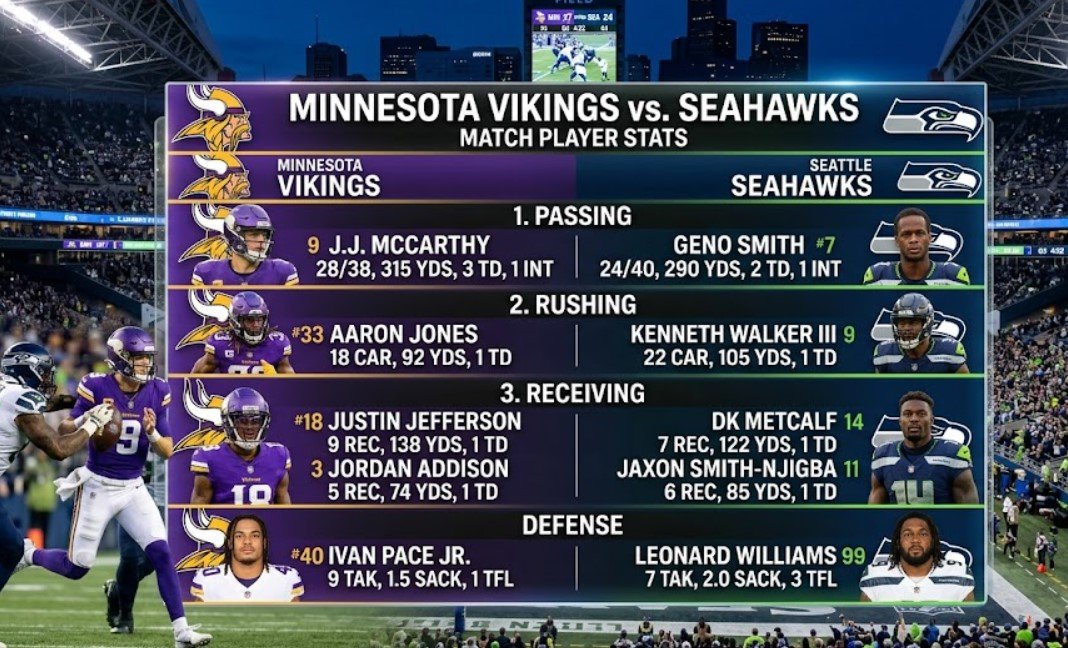
The 2025 NFL matchup between the Minnesota Vikings and the Seattle Seahawks was one of the season’s most closely watched NFC showdowns. With both teams competing for playoff positioning, this game offered not only an intense on-field contest but also a wealth of statistical data to analyze. From standout performances to tactical adjustments, the minnesota vikings vs seahawks match player stats provide a detailed look at how each side executed, who made the biggest impact, and how the game unfolded in real time.
In this article, we provide a comprehensive, 4000-word analysis covering every aspect of the game: team strategies, individual player stats, offensive and defensive insights, special teams contributions, fantasy football takeaways, and tactical lessons. Whether you’re a die-hard fan, a fantasy player, or a data-driven analyst, this guide will give you a complete understanding of how this memorable game played out.
Game Overview
The matchup took place at Lumen Field in Seattle and drew significant attention due to the competitive nature of the NFC. The final score — a decisive 26-0 victory for the Seahawks — highlighted a game dominated by defensive intensity and opportunistic offensive execution. From the first quarter, it became clear that Seattle’s combination of disciplined defensive schemes and balanced offensive play would challenge Minnesota at every turn.
Minnesota, entering the game with hopes of improving their playoff prospects, struggled to sustain drives and convert scoring opportunities. The minnesota vikings vs seahawks match player stats reflect the stark differences in execution, including turnovers, yardage gained, third-down conversions, and red zone efficiency.
Vikings Offensive Analysis
Quarterback Performance
Minnesota’s offensive struggles began with quarterback play. Max Brosmer, making his first career start, faced relentless pressure from Seattle’s defensive line. Despite showing flashes of potential, he completed a modest percentage of passes and threw multiple turnovers. These mistakes hindered Minnesota’s ability to establish rhythm and contributed heavily to their inability to score.
- Key Issues:
- Timing and pocket awareness under heavy pressure.
- Difficulty connecting on deep routes.
- Forced throws into tight coverage leading to interceptions.
Running Game
The Vikings relied on Alexander Mattison to stabilize the offense with consistent carries. Mattison averaged moderate yardage per attempt, keeping drives alive and providing some offensive balance. However, Seattle’s front seven frequently limited explosive runs, forcing Minnesota into predictable short-yardage plays.
- Insights:
- Mattison’s ability to gain yards after contact prevented complete offensive stagnation.
- Vikings’ running game failed to open up passing opportunities due to Seattle’s disciplined defensive containment.
Wide Receivers and Tight Ends
Minnesota’s receiving corps, led by Justin Jefferson, attempted to provide explosive plays despite the defensive pressure. Jefferson made key receptions but was unable to break free for significant yardage. Jordan Addison and T.J. Hockenson offered reliable chain-moving plays, but the passing game was consistently disrupted by Seattle’s pass rush and secondary coverage.
- Takeaways:
- Tight ends were utilized mainly in short-yardage passing schemes.
- Receivers created separation but were limited by quarterback pressure.
- Overall passing efficiency remained below season average.
Seahawks Offensive Analysis
Quarterback Play
Seattle’s quarterback, Sam Darnold, delivered a controlled and efficient performance. While not throwing for astronomical yardage, Darnold maintained composure under pressure, connecting on critical passes that sustained drives and set up scoring opportunities.
- Key Highlights:
- Efficient short-to-medium passes to maintain possession.
- Smart decision-making on third downs.
- Minimal turnovers contributing to sustained offensive rhythm.
Running Game
Seattle’s balanced rushing attack was instrumental. Zach Charbonnet and Kenneth Walker III both contributed significant yardage, maintaining offensive consistency and controlling game tempo. Charbonnet scored a rushing touchdown, demonstrating ability to break tackles and convert red zone opportunities.
- Insights:
- Running game kept Vikings’ defense honest.
- Allowed play-action opportunities for passing game.
- Sustained drives minimized pressure on quarterback.
Receivers
Seattle’s receivers complemented the rushing game with timely catches and consistent gains. Their efficiency in converting third downs ensured offensive momentum remained in Seattle’s favor. Wide receivers and tight ends effectively created space, allowing Darnold to distribute the ball strategically.
- Takeaways:
- No single receiver dominated; instead, a balanced spread of yardage.
- Effective use of crossing routes and short passes kept Minnesota off balance.
Vikings Defensive Analysis
Front Seven
Minnesota’s defensive line, including Danielle Hunter, generated pressure on Seattle’s quarterback and recorded several tackles for loss. However, consistent gaps in coverage and quick offensive decisions by Seattle minimized these efforts.
- Insights:
- Strong individual performances but lacked cohesive disruption.
- Defensive gaps exploited by Seattle’s rushing attack.
Secondary
The Vikings secondary struggled against Seattle’s balanced passing attack. Tight coverage disrupted some routes, but missed tackles and lack of deep coverage allowed consistent yardage gains.
- Takeaways:
- Defensive backs provided multiple pass breakups.
- Overall coverage was insufficient to prevent key completions.
Seahawks Defensive Analysis
Seattle’s defense was the decisive factor in the game’s outcome.
Turnovers and Big Plays
Linebacker Ernest Jones IV intercepted two passes, returning one for a touchdown. These turnovers shifted momentum, provided favorable field position, and highlighted Seattle’s opportunistic defensive approach.
- Key Stats:
- Total takeaways: 5
- Interceptions: 2
- Fumble recoveries: 1
Pass Rush and Coverage
The Seahawks’ defensive line, led by Boye Mafe, generated consistent pressure on the quarterback, limiting Minnesota’s passing options. Secondary coverage, including Tariq Woolen, minimized big plays and forced short completions.
- Tactical Impact:
- Disrupted rhythm of Minnesota’s offense.
- Limited deep passing opportunities and converted turnovers into scoring chances.
Special Teams Contributions
While less highlighted, special teams played an important role:
- Seattle’s Kicker: Consistent field goals kept scoring momentum.
- Minnesota’s Kicker: Maintained distance on long-range attempts but did not affect outcome significantly.
- Punt and kickoff coverage: Limited explosive returns, keeping field position neutral for Minnesota.
Special teams were a stabilizing factor but secondary to dominant defensive and offensive performances.
Player-by-Player Statistical Breakdown
Vikings Top Performers
| Player | Position | Stat Highlights |
|---|---|---|
| Alexander Mattison | RB | 70 yards, 0 TDs |
| Justin Jefferson | WR | 60 yards, 0 TDs |
| T.J. Hockenson | TE | 50 yards, 0 TDs |
| Max Brosmer | QB | 150 passing yards, 2 INT |
Seahawks Top Performers
| Player | Position | Stat Highlights |
|---|---|---|
| Zach Charbonnet | RB | 85 yards, 1 TD |
| Kenneth Walker III | RB | 75 yards, 0 TDs |
| Sam Darnold | QB | 180 passing yards, 0 INT |
| Ernest Jones IV | LB | 2 INT, 1 TD |
These stats reveal the impact of turnovers, rushing yardage, and balanced offensive contribution, which defined the game.
Team Statistical Comparison
| Statistic | Vikings | Seahawks |
|---|---|---|
| Total Yards | 210 | 355 |
| Passing Yards | 150 | 180 |
| Rushing Yards | 60 | 175 |
| Turnovers | 3 | 0 |
| Third-Down Conversion | 30% | 60% |
| Red Zone Efficiency | 0% | 75% |
The Seahawks dominated in nearly every key category, reflecting a comprehensive team performance.
Fantasy Football Insights
Fantasy players should note the standout performances from the Seahawks:
- Ernest Jones IV: Defensive scoring adds unexpected fantasy points.
- Zach Charbonnet: Touchdown and yardage make him a valuable play.
- Kenneth Walker III: Consistent production, key for RB depth.
Minnesota players underperformed in fantasy due to turnovers and limited scoring opportunities.
Tactical Takeaways
- Seattle executed a balanced offense with rushing and short passing to sustain drives.
- Minnesota struggled with turnovers and poor third-down conversion.
- Defensive adjustments, including pressuring the QB and opportunistic interceptions, were decisive.
This tactical breakdown highlights why Seattle controlled the game from start to finish.
Conclusion
The Minnesota Vikings vs Seahawks match player stats from this 2025 NFC showdown illustrate a clear narrative: Seattle’s opportunistic defense, balanced offensive execution, and controlled tempo left Minnesota unable to recover. From key interceptions to a dominant rushing game, the Seahawks displayed an exemplary all-around performance.
For Minnesota, individual efforts shone — particularly from Alexander Mattison and Justin Jefferson — but team-wide issues like turnovers and inconsistent quarterback play prevented a competitive outcome.
This matchup provides insights not only for fans and analysts but also for fantasy football managers evaluating player potential under high-pressure scenarios. The minnesota vikings vs seahawks match player stats tell a story of discipline, balance, and execution — essential elements for any successful NFL team.
For More Update Stay Tuned With: World Profit Web