
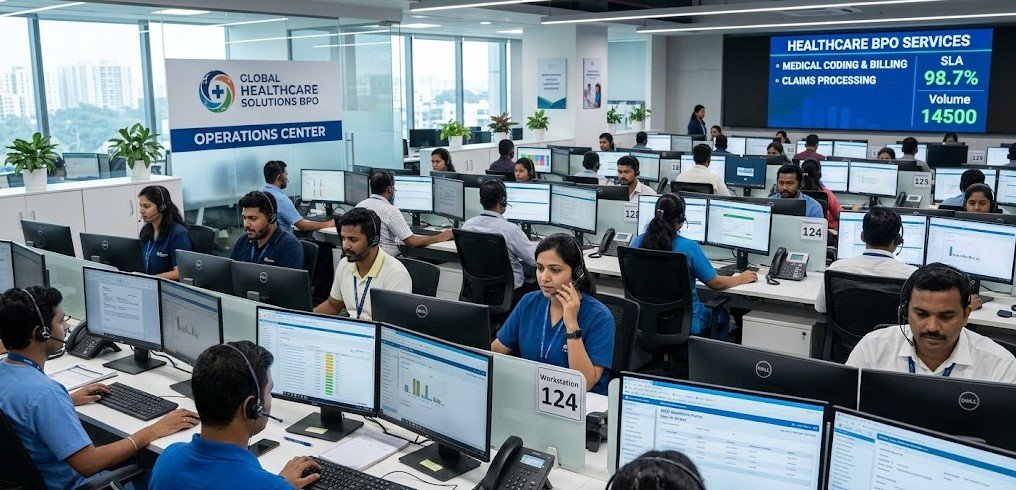
Healthcare BPO companies are specialized outsourcing firms that handle non-medical but essential administrative and operational tasks for hospitals, clinics, insurance providers, and pharmaceutical organizations. These tasks include medical billing, claims processing, patient data management, appointment scheduling, and revenue cycle management. By outsourcing these functions, healthcare providers can focus more on patient care and clinical services rather than spending time on complex back-office operations. In simple terms, healthcare BPO firms act as support systems that keep the healthcare industry running smoothly behind the scenes.
These companies have become an important part of the global healthcare ecosystem because they bring efficiency, accuracy, and cost savings. They use trained professionals and advanced digital tools to reduce errors in medical documentation and billing processes, which are critical in maintaining compliance with healthcare regulations. As healthcare systems grow larger and more complex, the demand for healthcare BPO companies continues to increase, especially in countries where healthcare infrastructure is rapidly expanding and patient volumes are rising.
Why Healthcare BPO Services Are Growing Globally
The demand for healthcare BPO companies is rising rapidly across the world due to increasing pressure on healthcare systems to reduce costs while improving service quality. Hospitals and insurance providers are handling larger volumes of patient data than ever before, which creates challenges in managing administrative tasks efficiently. Outsourcing these responsibilities to specialized BPO firms helps healthcare organizations focus more on patient treatment and less on paperwork-heavy processes. This shift is especially important in countries where healthcare demand is growing faster than internal staffing capacity.
Another major reason behind this global growth is the increasing adoption of digital healthcare systems and strict regulatory requirements. Healthcare providers must comply with standards related to data privacy, billing accuracy, and insurance claims processing, which can be complex and time-consuming. Healthcare BPO companies help organizations meet these requirements by using trained professionals and automated systems that reduce errors and improve turnaround time. Additionally, advancements in technology such as artificial intelligence and cloud-based platforms have made outsourcing more efficient, secure, and scalable, further driving global expansion in this sector.
Top Healthcare BPO Companies in the World
The global market for healthcare BPO companies is dominated by several well-established organizations that provide end-to-end outsourcing solutions for hospitals, insurance providers, and life sciences companies. These firms are known for their strong operational networks, advanced technology adoption, and ability to manage large-scale healthcare processes. Leading companies such as Accenture, Cognizant, and Genpact have built a strong reputation by offering services like revenue cycle management, claims processing, and healthcare analytics. Their global presence allows them to serve healthcare systems in the United States, Europe, and Asia efficiently.
Alongside IT-driven giants, there are also specialized healthcare-focused BPO providers that play a major role in the industry. Companies like Omega Healthcare, GeBBS Healthcare Solutions, and Conduent are widely recognized for their expertise in medical coding, billing, and patient support services. These organizations focus specifically on healthcare operations, making them highly efficient in handling domain-specific challenges. The growing reliance on healthcare BPO companies reflects how critical outsourcing has become in improving healthcare efficiency, reducing operational costs, and ensuring compliance with strict medical regulations across different regions.
Key Services Offered by Healthcare BPO Companies
Healthcare BPO companies provide a wide range of services that support hospitals, clinics, insurance providers, and pharmaceutical firms in managing their daily operations more efficiently. One of the most important services is revenue cycle management (RCM), which includes medical billing, coding, and claims processing. These services ensure that healthcare providers receive timely payments from insurance companies while maintaining accuracy and compliance with healthcare regulations. In addition, many BPO firms also handle patient registration, appointment scheduling, and medical transcription, which helps reduce the administrative burden on healthcare staff.
Another major area of service is patient support and data management. Healthcare organizations often deal with large volumes of sensitive patient information, and BPO companies help in organizing, storing, and processing this data securely. They also provide customer support services such as handling patient inquiries, insurance verification, and helpdesk operations. With the integration of digital tools and automation, healthcare BPO companies are now able to deliver faster response times, reduce human errors, and improve overall patient satisfaction. These services play a crucial role in ensuring smooth healthcare operations and better coordination between patients, providers, and payers.
Benefits of Outsourcing to Healthcare BPO Firms
One of the biggest advantages of working with healthcare BPO companies is significant cost reduction. Healthcare organizations often struggle with high administrative expenses, especially when managing in-house teams for billing, coding, and claims processing. By outsourcing these tasks, hospitals and insurance providers can reduce operational costs while still maintaining high-quality service delivery. This allows healthcare institutions to allocate more resources toward patient care, medical equipment, and clinical improvements rather than administrative overhead.
Another important benefit is improved efficiency and accuracy in healthcare operations. Healthcare BPO companies use trained professionals and advanced technologies to handle complex processes with fewer errors, especially in areas like medical coding and insurance claims. This leads to faster claim approvals, reduced delays, and better cash flow for healthcare providers. Additionally, outsourcing partners often work in multiple shifts across different time zones, ensuring 24/7 support and quicker turnaround times, which ultimately improves patient satisfaction and overall service quality.
Challenges in Healthcare BPO Industry
Despite the rapid growth of healthcare BPO companies, the industry faces several challenges that can impact service quality and operational efficiency. One of the major concerns is data security and patient privacy. Healthcare organizations handle highly sensitive information such as medical records, insurance details, and personal identifiers. Any breach or mishandling of this data can lead to serious legal consequences and loss of trust. As a result, BPO providers must continuously invest in advanced cybersecurity systems and strict compliance measures like HIPAA and other regional healthcare regulations.
Another significant challenge is maintaining accuracy and consistency in processes such as medical coding, billing, and claims management. Even a small error can lead to claim rejections, payment delays, or compliance issues. Additionally, healthcare BPO companies must deal with frequent regulatory changes across different countries, which requires constant training and system updates. Workforce management is also a challenge, as the industry depends heavily on skilled professionals who understand both healthcare and technology. High employee turnover in some regions can further affect service continuity and quality.
Future Trends in Healthcare BPO Sector
The future of healthcare BPO companies is expected to be strongly shaped by technology, automation, and data-driven decision-making. One of the biggest trends is the increased use of artificial intelligence (AI) and machine learning to automate repetitive tasks such as claims processing, medical coding, and patient data entry. This not only reduces human error but also speeds up operations, allowing healthcare providers to process large volumes of data more efficiently. Cloud-based healthcare systems are also becoming more popular, enabling real-time access to patient records and improving collaboration between different healthcare stakeholders.
Another major trend is the shift toward value-based care and analytics-driven healthcare management. Healthcare BPO companies are increasingly focusing on providing insights rather than just basic administrative support. This includes predictive analytics for patient outcomes, fraud detection in insurance claims, and performance optimization for healthcare providers. Additionally, the industry is expanding globally, with more outsourcing hubs emerging in regions like Asia-Pacific due to cost advantages and skilled workforce availability. As healthcare systems continue to evolve, BPO firms will play an even more strategic role in improving efficiency, patient experience, and overall healthcare outcomes.
Conclusion
The growth of healthcare BPO companies has significantly transformed the global healthcare industry by improving efficiency, reducing operational costs, and enhancing patient service quality. As healthcare systems continue to expand and generate massive volumes of data, outsourcing non-core tasks such as billing, coding, claims processing, and patient support has become essential. These companies not only streamline complex administrative processes but also help healthcare providers focus more on delivering better clinical care. With the integration of advanced technologies like AI, automation, and cloud computing, the role of healthcare BPO firms is becoming even more strategic and impactful in modern healthcare ecosystems.
Looking ahead, the future of healthcare BPO companies appears highly promising, with continued innovation and global expansion shaping the industry. However, success will depend on how well these firms manage challenges such as data security, regulatory compliance, and accuracy in healthcare processes. Overall, healthcare BPO services are no longer just support functions—they are now a core part of the healthcare value chain that drives performance, scalability, and improved patient outcomes.
FAQs
1. What do healthcare BPO companies do?
They handle non-clinical tasks like medical billing, coding, claims processing, and patient support services for healthcare providers.
2. Why are healthcare BPO companies important?
They reduce operational costs, improve efficiency, and help healthcare organizations focus more on patient care.
3. Which services are most common in healthcare BPO?
Medical billing, revenue cycle management, insurance claims processing, and patient data management are the most common services.
4. Is healthcare BPO a growing industry?
Yes, it is rapidly growing due to increasing healthcare demand, digital transformation, and the need for cost-efficient operations.
For More Update Stay Tuned With: World Profit Web